

Clear records
history record
Waterproof 7 Inch Backup Camera System for Heavy Duty Truck Safety
Why Waterproof Rear Visibility Systems Matter More Than Ever for Heavy Duty Trucks
In today’s commercial transportation industry, vehicle safety is no longer viewed as an optional upgrade—it has become a core operational priority. As trucks become larger, routes become more demanding, and safety regulations become stricter, fleet operators and vehicle owners are under increasing pressure to reduce risk while improving driving efficiency. Among the most practical safety technologies available today, the 7 inch backup camera system has become one of the most effective tools for improving rear visibility and preventing reversing-related accidents.
For heavy-duty trucks, reversing is one of the most difficult and dangerous driving tasks. Limited rear sightlines, oversized trailers, poor weather conditions, and blind spots all contribute to higher accident rates. A well-designed waterproof 7 inch backup camera system helps solve these problems by delivering real-time visual support through high-definition imaging, wide-angle coverage, advanced night vision, and durable weather-resistant construction.
Understanding how these systems work—and what features truly matter—can help buyers choose equipment that improves both safety and long-term vehicle performance. In this blog post, Shenzhen HOPE, as high quality commercial vehicle camera systems manufacturer, will share the features of waterproof 7 inch backup camera system for heavy duty truck safety.
Why the 7-Inch Monitor Size Has Become the Preferred Standard for Commercial Vehicles
When selecting a backup camera system, monitor size directly affects usability and driver response time. A display that is too small can make it difficult to identify obstacles clearly, while an oversized monitor may interfere with dashboard visibility or distract the driver.
This is exactly why the 7 inch backup camera system has become the preferred choice across commercial transportation sectors. It provides an ideal balance between viewing comfort and dashboard compatibility.
A 7-inch display offers enough screen space to show detailed rear images without forcing drivers to strain their eyes or shift their attention excessively. For truck drivers who spend long hours behind the wheel, this ergonomic advantage becomes especially important. Whether reversing into a loading dock, aligning with a trailer, or maneuvering through a narrow industrial yard, the larger visual field helps reduce hesitation and improve accuracy.
As a result, this screen size has become widely adopted in trucks, buses, RVs, trailers, and fleet vehicles worldwide.
Why Waterproof Construction Is Essential for Long-Term Outdoor Performance
Heavy-duty trucks rarely operate in ideal conditions. They are exposed to rain, dust, road salt, mud, snow, vibration, and frequent vehicle washing. These environmental factors can quickly damage standard electronic components, especially lower-grade camera systems.
This is why waterproof performance should never be treated as a secondary feature.
A 7 inch backup camera system with IP68 waterproof protection is designed specifically for demanding outdoor use. The sealed camera housing prevents water intrusion during storms or pressure washing, while dustproof construction protects internal sensors from contamination. In addition, corrosion-resistant materials help maintain image quality and structural integrity over extended use.
For commercial operators, this durability matters because it directly affects maintenance frequency, replacement cycles, and equipment reliability. A camera that fails during bad weather is not simply inconvenient—it creates an immediate safety risk.
How 1080P Resolution Improves Reversing Accuracy and Driver Confidence
Image clarity is one of the most important factors in any backup camera system. Older analog systems often produce blurry or distorted images, forcing drivers to estimate distances rather than clearly seeing hazards.
A modern 1080P 7 inch backup camera system eliminates this problem by providing significantly sharper visual detail.
With a full HD rear camera resolution of 1920×1080, drivers can identify smaller obstacles much earlier. This includes low curbs, tools left on loading docks, pedestrians, trailer hitches, and other vehicles. The improved image quality also helps drivers judge distance more accurately, which is especially important when reversing large trucks in confined spaces.
For commercial operations where precision matters—such as warehouse docking, trailer coupling, and urban deliveries—high-definition imaging can dramatically reduce both accident risk and maneuvering time.
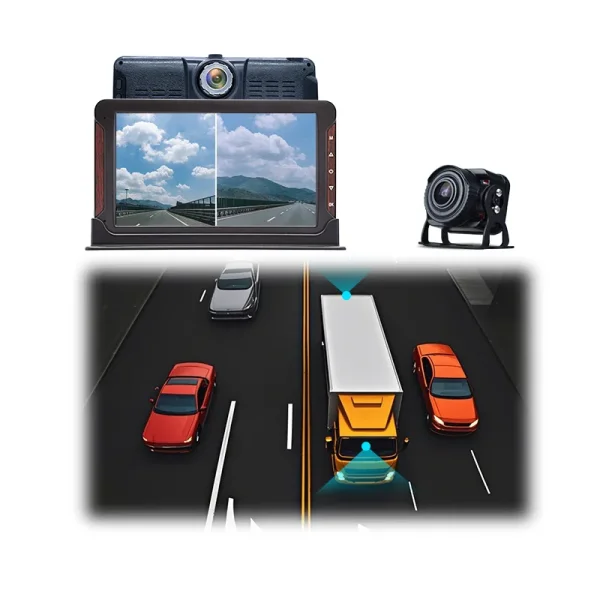
Why Wide-Angle Camera Coverage Helps Eliminate Dangerous Blind Spots
Blind spots are one of the most common causes of reversing accidents involving heavy-duty vehicles. Traditional mirrors simply cannot provide complete rear visibility, especially when trailers or cargo obstruct the view.
A 7 inch backup camera system with a wide-angle lens helps solve this challenge by dramatically expanding the driver’s field of vision.
With approximately 100 degrees of coverage, a wide-angle camera allows drivers to see more of the surrounding environment, including areas near the rear corners of the vehicle that mirrors often miss. This added visibility is especially valuable when parking in crowded loading zones, backing into tight industrial spaces, or navigating busy urban streets.
By reducing visual uncertainty, wide-angle technology helps drivers make safer and faster decisions during reversing maneuvers.
How Night Vision Technology Supports Safer Truck Operation After Dark
Commercial vehicles do not stop operating when the sun goes down. Night deliveries, early morning departures, warehouse loading, and emergency transportation all require reliable visibility in low-light conditions.
Without proper night vision, rear camera performance can decline sharply.
A professional-grade 7 inch backup camera system with night vision uses advanced technologies such as infrared illumination, starlight sensors, and low-light image processing to maintain clear visibility after dark.
This means drivers can continue reversing safely in underground garages, dim industrial yards, poorly lit streets, and rural environments. Instead of relying on guesswork, they receive a clear and stable rear image—even when ambient lighting is limited.
For fleets operating around the clock, night vision is not a luxury—it is a necessity.
Why Touchscreen Controls Improve Daily Usability for Drivers
Ease of use plays a major role in driver adoption. If a system is difficult to operate, drivers may avoid using it correctly.
Modern touchscreen 7 inch backup camera systems improve usability by replacing complex buttons with intuitive controls. Drivers can quickly switch between cameras, adjust brightness, access recording settings, or review footage with minimal distraction.
This matters especially in fleet environments where multiple drivers may use the same truck. A simpler interface reduces training time and encourages consistent system usage.
Better usability ultimately leads to better safety outcomes.
How Built-In Recording Features Add More Than Just Rear Visibility
Today’s advanced camera systems do more than show live rear images—they also provide digital recording capabilities.
A DVR-enabled 7 inch backup camera system allows operators to store footage directly onto memory cards, often supporting capacities up to 256GB.
This recording function offers several operational benefits. It can help document accidents, support insurance claims, improve driver training, and provide additional security monitoring when vehicles are parked.
For fleet owners, this turns a simple camera system into a broader risk management tool, increasing overall return on investment.
Why Voltage Compatibility Is Critical for Commercial Vehicle Installations
Unlike passenger vehicles, commercial fleets operate on a wide range of electrical systems. Some trucks run on 12V platforms, while others require 24V or higher support.
That is why professional buyers should always verify voltage compatibility.
A 7 inch backup camera system supporting DC 9–36V offers the flexibility needed for diverse vehicle types, including heavy trucks, buses, trailers, agricultural machinery, and emergency vehicles.
This broader compatibility simplifies installation and avoids the need for separate voltage converters, reducing both installation complexity and failure risk.
Why Temperature Resistance Determines Long-Term Product Reliability
Backup cameras mounted on commercial vehicles must survive extreme weather.
In cold climates, electronics may freeze or lose responsiveness. In hot environments, overheating can damage internal components and reduce lifespan.
A professional 7 inch backup camera system for heavy-duty trucks should support wide operating temperatures, typically from -20°C to 70°C, with even broader storage tolerance.
This ensures dependable performance whether the vehicle is traveling through winter highways, hot desert routes, or refrigerated transport environments.
Long-term reliability begins with environmental resilience.
What Buyers Should Evaluate Before Choosing the Right System
Not all backup camera systems are built to commercial standards. Buyers should carefully compare key performance indicators before making a decision.
Important evaluation points include image resolution, waterproof certification, viewing angle, night vision capability, voltage range, display responsiveness, storage support, and installation flexibility.
Price alone should never be the deciding factor. A cheaper system that fails prematurely often becomes more expensive over time due to replacements, downtime, and safety risks.
Choosing a durable, well-designed 7 inch backup camera system provides stronger long-term value.
Why Proper Installation Has a Direct Impact on System Performance
Even the best hardware can underperform if installed incorrectly.
Camera positioning must be optimized to avoid blind spots while protecting the lens from impact. The monitor should be mounted at a natural viewing angle to minimize driver distraction. Wiring must be sealed against water intrusion and protected from vibration-related wear.
For commercial fleets, standardized installation procedures are highly recommended. Proper installation ensures the system delivers the performance buyers expect.
How Backup Camera Technology Is Shaping the Future of Truck Safety
The future of truck safety is increasingly driven by intelligent visibility systems.
New innovations such as wireless connectivity, split-screen multi-camera viewing, AI obstacle detection, and integration with driver assistance systems are expanding the role of rear-view technology.
However, the foundation remains unchanged: drivers need clear images, reliable durability, and dependable operation in all conditions.
That is exactly why rugged waterproof 7 inch backup camera systems continue to dominate the heavy-duty vehicle market.
Final Thoughts
A 7 inch backup camera system has evolved far beyond a simple reversing aid. For heavy-duty trucks, it has become an essential safety solution that supports better visibility, faster maneuvering, and reduced operational risk.
When equipped with 1080P HD imaging, IP68 waterproof protection, wide-angle coverage, night vision, and touchscreen functionality, these systems provide measurable value for truck owners, fleet managers, and commercial operators.
Investing in the right system means more than installing a camera—it means building a safer, smarter, and more efficient transportation operation.