

Clear records
history record
HOPE Technology | The Importance of Installing Dashcams on Large-Scale Mining Equipment

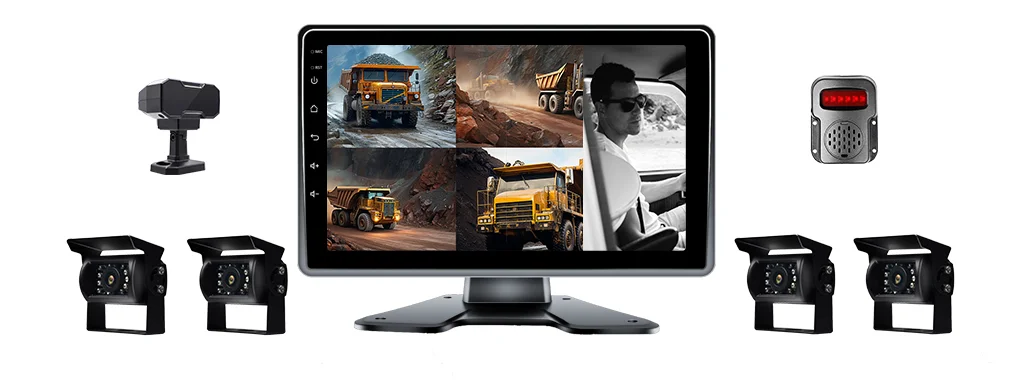
Large-scale mining equipment operates in harsh environments, features massive dimensions and extensive blind spots, and entails high safety risks; consequently, the installation of specialized front and back dashcam, and blind-spot radar systems constitutes a critical configuration for ensuring safe mining operations, enhancing management efficiency, and minimizing accident-related losses. In this blog post, Shenzhen HOPE, as high quality truck dashcams manufacturer, will share the importance of installing dashcams on large-scale mining equipment.
The Importance of Installing Professional Dashcams
Authoritative Accident Evidence Collection
Records work operations and the surrounding environment in high definition from start to finish through front and rear dashcam systems, enabling the rapid reconstruction of events and the determination of the truth following an accident.
Precise GPS Positioning
Supports real-time location tracking and route playback, allowing for the precise monitoring of equipment location, travel routes, and operational zones. This eliminates issues such as unauthorized driving, route deviations, and unauthorized usage, thereby enabling comprehensive, area-wide supervision.
Remote Real-Time Monitoring
Managers can remotely view live video feeds captured by dashcams via a backend management system, eliminating the need for on-site presence and enabling more timely and efficient operational control.
Efficient Remote Management
Features include over-speed alerts, recording of abnormal driving behaviors, and work-hour statistics. Combined with front and back dashcam data, these functions help standardize driving practices, mitigate the risks associated with driver fatigue and reckless operation, and significantly boost overall fleet management efficiency.
Adapted for Harsh Mining Environments
The product features a robust design engineered to withstand shock, dust, and high temperatures, while also supporting a wide voltage range. Integrated front and rear dashcam configurations reliably handle the extreme operating conditions typical of mining sites—including rough terrain, heavy dust, and complex power supply environments—ensuring long-term, dependable performance.
FAQ
1. Why are truck dashcams necessary for mining operations?
Truck dashcams are essential in mining environments due to the large size of equipment and significant blind spots. They provide continuous video recording, improve operational visibility, and offer reliable evidence in case of accidents.
2. What is the difference between a front and back dashcam and a front and rear dashcam?
There is no functional difference—both refer to systems that record video from the front and rear of the vehicle. The terms front and back dashcam and front and rear dashcam are interchangeable, depending on regional or industry terminology.
3. How does a front and rear dashcam improve fleet management?
A front and rear dashcam allows managers to monitor both forward and backward driving conditions, helping detect unsafe behaviors, improve driver accountability, and optimize operational efficiency through recorded data and real-time monitoring.
4. Can truck dashcams support remote monitoring?
Yes, most modern truck dashcams support remote real-time monitoring via network connectivity. Managers can access live footage, track vehicle routes, and review historical recordings without being physically present on-site.
5. Are truck dashcams suitable for harsh mining environments?
Professional truck dashcams are specifically designed for extreme conditions. They feature rugged construction, resistance to dust and vibration, and stable performance under high temperatures and fluctuating power supply, ensuring reliable long-term operation.